A hand-bound book in Nüshu, the women-only script of Hunan.
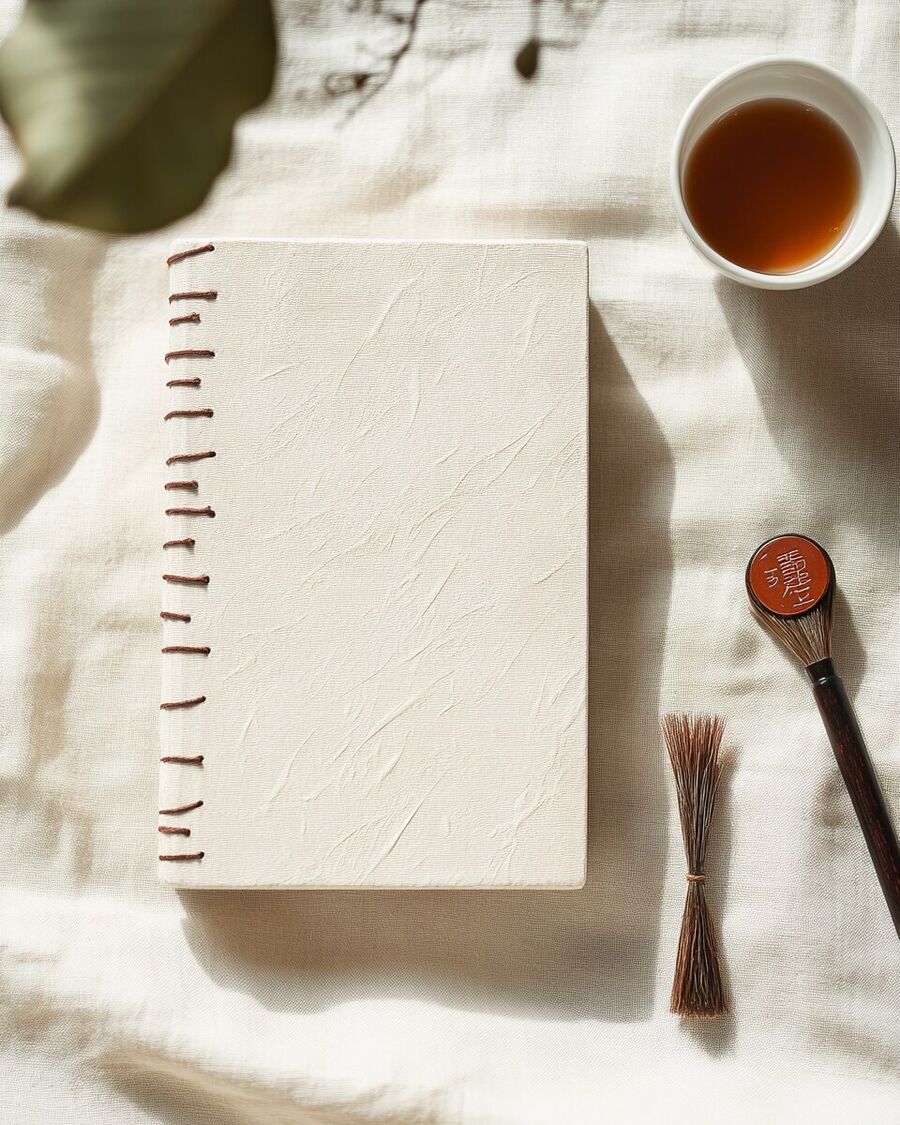
The book itself is still in production. Photographs and full details will go up here when it is ready. What follows is what the object is, and why it exists at all.
女書
Nüshu is a syllabary, not a set of word-characters: each of its roughly six to seven hundred symbols stands for a sound, and the same symbol serves every word that shares that sound. It does not write Mandarin. It writes Xiangnan Tuhua, the local speech of Jiangyong County in Hunan — so a reader who knows only standard Chinese cannot read it even after learning the shapes.
The letterforms are long, thin and slanted, built from dots, arcs and slashes leaning to the right. Fine, thread-like strokes were the mark of a good hand. It was written on paper and fans and handkerchiefs, woven into belts, and embroidered onto cloth — which is to say it lived on the objects women were already permitted to make.
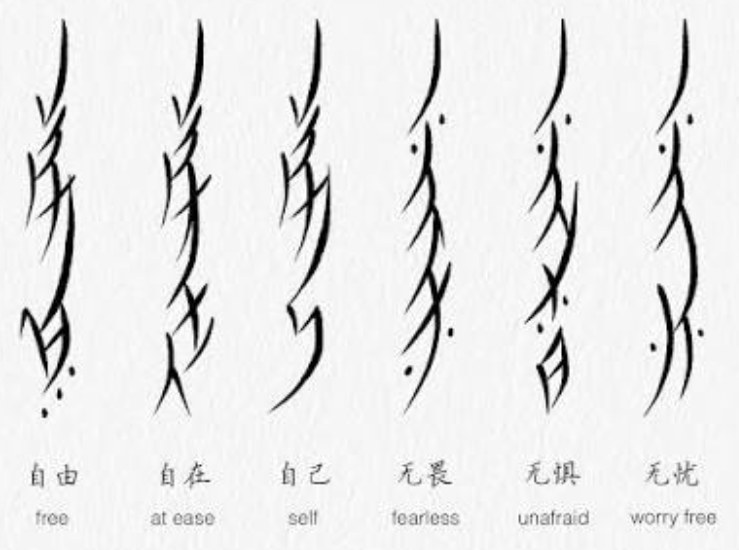
Six words in Nüshu. Note the rightward lean, the thread-thin strokes, and the tall rhomboid column — nothing like the square block of a Chinese character. Each one writes a sound in the local speech, not a meaning, which is why the same shapes can serve different words.
This is a script that exists because of an exclusion. In the society that produced it, most women were never taught the characters men used. Rather than remain unwritten, they built a second system out of the first, simplified past the point where the two remain related.
Upstairs, and between sisters.
Unmarried girls were known as “upstairs girls,” kept largely to the upper chamber of the house, where they embroidered and sang together. Nüshu passed hand to hand in those rooms — mother to daughter, and between the sworn sisters of 结拜 jiebai, unrelated women who pledged themselves to one another for life. It was learned by singing as much as by copying: the 女歌 nüge, women’s songs, carried both the words and the script.
What survives is therefore not literature in the public sense. It is correspondence — written to one named woman, by one named woman, about a life the two of them shared.
三朝书
A marriage removed a woman from the village she had grown up in and delivered her to a household of strangers. Three days after the wedding, her mother and her sworn sisters sent her a cloth-bound booklet: the 三朝书, the third-day book.
Inside were songs — good wishes for the marriage, and open grief at the separation, the two set down on the same page without either cancelling the other. Most of the book was left blank. The bride was expected to fill the remaining pages herself, in her new house, in her own hand.
A book given half-finished, on purpose, to a woman who had just been sent away.
Most of it was buried.
Nüshu was written to be destroyed. As women neared death they asked that some of their writing be placed in the coffin with them and the rest burned, so that it travelled with the woman it belonged to. The corpus was never meant to outlive its writers, and largely didn’t. What survived that was thinned again by the Japanese occupation in the 1930s and 40s, and again during the Cultural Revolution, when the script was treated as occult — Zhou Shuoyi, the one man known to have mastered it and the compiler of its first dictionary, was persecuted for the work.
Schooling, not suppression.
It is tempting to read Nüshu as a script that was stamped out. It wasn’t. Censorship destroyed artefacts; it did not kill the writing. What ended Nüshu was girls being sent to school.
Standardised, compulsory education put ordinary women in classrooms learning the same characters as their brothers. The exclusion that had made a second script necessary simply stopped applying — and a woman who can write Chinese has no reason to write a syllabary only her sworn sisters can read. Nüshu did not lose an argument. It lost its purpose, which is a stranger and less consoling way for a writing system to go.
The condition that created it was the condition that sustained it. Remove one and you remove both.
A living script, barely.
- Yang HuanyiLast fluent natural writer · d. 2004, aged 98
- He YanxinLast natural inheritor · d. October 2025, aged 86
- 2006Listed as national intangible cultural heritage
- 2017396 characters encoded in Unicode 10.0
Everyone still writing Nüshu today learned it as heritage rather than as a living necessity. The chain of women who were taught it because they had no other way to write ended within the last year.
This edition follows that form — hand-bound, written out, and left partly empty. It is a new book in an old shape.
Preserving a script with no native writers.
A first distinction, because it gets blurred: the speech Nüshu records still has speakers. Tuhua is spoken in Jiangyong today. What has no natives is the practice — women learning this script from other women because no other writing was available to them. Everyone who writes Nüshu now learned it as heritage, by choice, with standard Chinese already in hand.
So the characters are safe. They are dictionaried, catalogued, taught in classrooms and encoded in Unicode; nothing about the letterforms is at risk. What cannot be preserved is the use, because the use required the exclusion, and the exclusion is gone. You would have to un-educate a generation of women to get Nüshu back.
That leaves preservation meaning one of two honest things. Either the script becomes an object of study — archived, transcribed, read by scholars. Or it gets picked up and used for something new by people who chose it rather than needed it, which is also legitimate, and is not the same thing, and should stop claiming to be. The failure mode is the third option: the letterforms stripped off and sold as a motif, on a tote bag or a tattoo or a brand, while the content — grief, and intimacy between two named women — is discarded. That preserves the handwriting and throws away the writing.
There is one more turn, and it belongs to the women themselves. They burned theirs. They asked for it in the coffin. A tradition whose own practitioners treated their writing as belonging to a person rather than to posterity sits oddly with any argument that it must be kept intact forever. They were not archivists. They were correspondents.
Which is why this is made as a book to be written in, and not as a replica to be kept.